Friday, 22 November 2025
Introduction
In industrial and commercial process-cooling applications, the choice of chiller technology is critical. Among screw-compressor chillers, two predominant configurations exist: the air cooled screw chiller and the Water Cooled screw chiller. At Airtech Cooling Process Pvt Ltd, we offer both types through our product lines: our air cooled Screw Chiller and Water Cooled Screw Chiller. The right selection depends on your cooling load, site constraints, operating cost targets, water and space availability, and other factors. This blog sets out the salient features of each, key differences, and selection considerations, so that end-customers and site visitors of our website can make a well-informed decision.
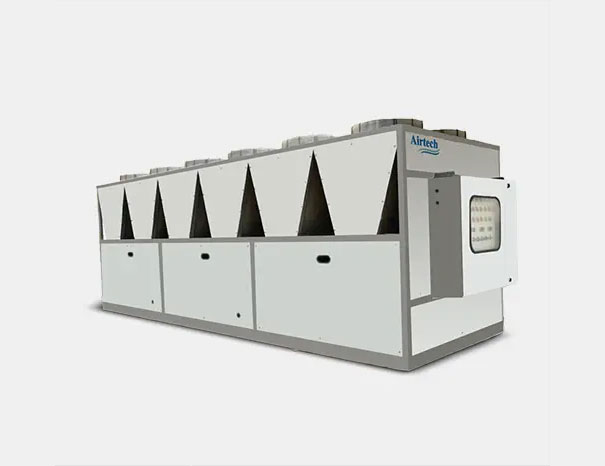
Salient Features of air cooled Screw Chillers
The air cooled screw chiller uses a screw compressor as the core refrigeration unit, with the condenser rejecting heat directly to ambient air via fans and finned‐coil heat exchangers. Key features include:
- Simpler installation: since no external cooling tower water loop is required, the layout and infrastructure are less complex.
- Outdoor installation friendly: the unit can often be installed outdoors (roof-mounted, yard, etc) since ambient air is the heat sink.
- Water-independent: Because there's no need for a condenser water loop or cooling tower, the system avoids water consumption, water treatment, and associated maintenance. This is particularly important in water-scarce areas.
- Lower upfront civil/plant infrastructure: absence of cooling tower, condenser water piping means lower initial site preparation cost in some cases.
- Suitable for moderate to small-medium loads: air cooled screw chillers are very effective where cooling loads are moderate and ambient conditions allow efficient rejection. For example, some sources note air cooled units may cover up to several hundred tons.
- Maintenance advantages: With only air as the medium, issues such as water‐treatment, scaling, corrosion of condenser water piping/towers are avoided.
On our website’s air cooled Screw Chiller page, you will find model categories, performance charts and typical applications, which reinforce those benefits.
Salient Features of Water Cooled Screw Chillers
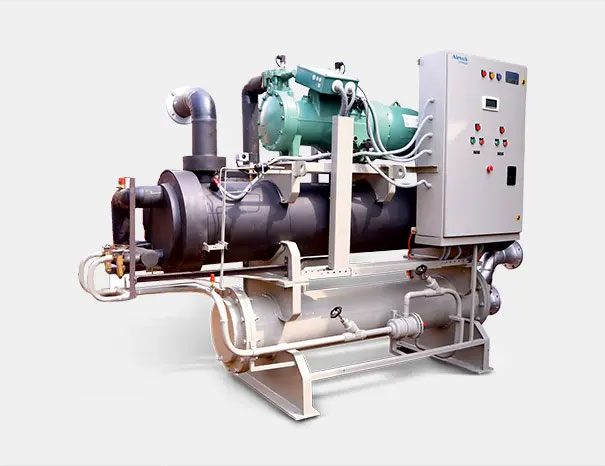
Water Cooled screw chillers also use a screw compressor, but the condenser rejects heat into a closed condenser‐water loop, which then passes through a cooling tower or fluid cooler to the environment. Key features are:
- Higher thermodynamic efficiency: Because water has much higher heat capacity and the condenser can reject to a lower temperature (wet-bulb rather than dry-bulb ambient) the system tends to run at lower condensing pressures and thus higher efficiency
- Larger capacity applicability: Water Cooled systems are better suited to large-scale installations (data centres, large factories, central cooling plants) because they can handle higher loads and maintain good efficiency.
- Indoor installation flexibility: The chiller itself can be placed indoors (or within a mechanical room) since the heat rejection is via an external tower; this is useful where outdoor space is constrained or noise must be minimized.
- Longer service life: Some literature suggests that Water Cooled chillers, when properly maintained, may have a longer lifespan due to more controlled condenser conditions.
- Lower operating cost (in many cases): Though the initial installation is more complex, annual operating cost (per ton of cooling) often comes out lower when water supply, tower maintenance etc are optimised.
On our website’s Water Cooled Screw Chiller page you will find model ranges, performance tables and typical reference installations – illustrating how Airtech supports large-scale process cooling needs.
Key Differences & Selection Considerations
Here’s a structured comparison of the two technologies along major criteria:
| Criteria | air cooled Screw Chiller | Water Cooled Screw Chiller |
|---|---|---|
| Initial Installation Cost | Typically lower infrastructure cost (no cooling tower or condenser-water loop) | Higher upfront due to cooling tower, condenser water pumps, piping, water treatment system |
| Operating Efficiency / Energy Cost | Dependent on ambient air dry‐bulb temperature; efficiency falls when ambient is high. | Better efficiency due to ability to reject at wet-bulb and better heat-transfer medium; better suited for high‐load, continuous operation |
| Water Usage & Treatment | No cooling-tower water consumption, no tower maintenance – advantage where water is scarce or expensive | Requires condenser water loop + cooling tower => needs water treatment, blow‐down, corrosion control, more maintenance |
| Space & Location Constraints | Needs good ambient air flow; outdoor install preferred; outdoor noise/fan impact needs consideration | Chiller can be indoors; tower can be placed remotely; better for compact indoor plant rooms or where outdoor fan noise matters |
| Noise & Aesthetic Impact | Fans and outdoor unit may generate more noise; outdoor visibility must be managed | Cooling tower fans remote; indoor placement can reduce noise impact in occupied spaces |
| Capacity / Scalability | Well suited for small to medium loads; above certain tonnage the efficiency and layout may become less favourable | Suited to large central plants, heavy duty loads, and where future expansion is expected |
| Maintenance & Life-Cycle Considerations | Easier maintenance (air side only), fewer water‐treatment issues; but ambient stress may reduce life-span in harsh outdoor environments | More complex maintenance (water side, tower, pumps), but better controlled operating conditions may enhance longevity |
| Water Availability / Environmental Issues | Ideal where water supply is limited, or water cost/regulations restrictive | Requires good water supply, and may be impacted by water intake/discharge regulation |
| Site Ambient Conditions | If ambient air is very hot or humid, the air cooled unit may struggle (condensing pressure rises) | Performs more consistently even in high ambient; less impacted by dry-bulb fluctuations |
| Total Cost of Ownership (TCO) | Lower upfront but potentially higher energy cost over life if ambient is such that efficiency is compromised; simpler infrastructure | Higher upfront, but lower operating cost if the system is large/continuous, water cost acceptable |
How to Choose Between the Two – Selection Checklist
When a customer is evaluating whether to select an air cooled or Water Cooled screw chiller from Airtech, here are key questions to ask:
- Cooling load & usage pattern – What is the peak tonnage requirement, and what are the operating hours (continuous, 24/7; or intermittent)? Higher loads and continuous operation favour Water Cooled for efficiency, whereas smaller or intermittent loads may make air cooled more economical.
- Site ambient conditions & installation location – Is the chiller to be installed outdoors with good air flow and acceptable ambient temperatures? If yes, air cooled may work. If ambient is very high, or ventilation poor, Water Cooled may be more stable.
- Water availability and quality – Is there reliable water supply and acceptable water quality (for tower blow-down, make-up water, treatment)? If water is limited or costly, an air cooled solution may be preferred.
- Space & infrastructure constraints – Is there room for a cooling tower, water pumps, piping, and treatment plant? Are noise and aesthetic restrictions in place (e.g., in an urban campus)? If space/visual/noise constraints exist, a Water Cooled system with indoor chiller and remote tower may be better.
- Operating cost vs capital cost trade-off – Do you prioritise lowest upfront investment, or lowest long-term energy/maintenance cost? For smaller scale or budget-sensitive projects, the lower install cost of air cooled might be attractive. For large‐scale plants where lifetime energy cost dominates, Water Cooled may deliver lower total cost of ownership.
- Maintenance and lifecycle expectations – Consider ease of maintenance, access, water-treatment regime, expected lifetime. If simplicity is valued and maintenance resources limited, air cooled could be less burdensome. If you have a full facility-management team, Water Cooled may deliver better performance.
- Future expansion or service flexibility – – Anticipating growth, or multiple chillers in parallel, may influence the choice. Water Cooled systems scale well for large loads and integration into central plant. air cooled systems may be easier to modularly add but may hit limitations eventually.
Why Choose Airtech Cooling Process Pvt Ltd?
Here are five major points as to why you should consider Airtech Cooling Process Pvt Ltd for your next air- or Water Cooled screw chiller system:
- Comprehensive product offering – Airtech offers both air cooled screw chillers and Water Cooled screw chillers, enabling you to choose the best technology for your site rather than being constrained to a single option.
- Technical expertise & customisation – With deep experience in process cooling, Airtech provides customised solutions tailored to your cooling load, ambient conditions, water/space availability and energy-cost objectives. We guide you through the selection checklist above.
- Quality performance & reliability – Our screw-compressor chillers are built for durability, efficiency and serviceability. By selecting the right technology and maintaining it with our support, you can achieve reliable performance over years.
- After-sales and support infrastructure – We support installation, commissioning, maintenance and lifecycle support. Given the technical nature of chiller systems (water treatment, condenser cleaning, control tuning) you want a partner with strong service capability.
- Single-source accountability – From design through installation and service, Airtech offers end-to-end responsibility. This ensures clarity, schedule reliability and a single point of contact—making project procurement, commissioning and hand-over simpler.
Conclusion
Selecting between an air cooled screw chiller and a Water Cooled screw chiller is not simply a matter of “which one is better” — it depends on a nuanced evaluation of cooling load, ambient conditions, water availability, infrastructure and lifecycle cost. At Airtech Cooling Process Pvt Ltd, we provide both technologies, and our role is to help you identify the optimal solution: whether it is the simplicity and water‐independence of the air cooled route, or the higher efficiency and large-scale capability of the Water Cooled option. Use the above selection criteria, refer to our product pages, and engage with our technical team to arrive at the right decision for your facility.
We look forward to being your trusted partner in process cooling.
For inquiries, you can reach Airtech Cooling through the website www.airtechcool.com, via email at info@airtechcool.com , or on WhatsApp at +91 9350511679 to discuss your requirements.
Published by Ayush Kathuria